Print on demand UK

Print on demand,
or short-run printing?

Most UK authors searching for "print on demand" actually get better value from short-run book printing. We're not a POD provider — we're a real UK bookbindery, printing and binding from 10 copies up. Here's the honest comparison: when POD makes sense, when short-run wins, and how the per-copy economics actually work.

4.9 ★★★★★
132 Google reviews
10+
Minimum copies
From £2.50
Per copy at 250
5–10 days
Paperback turnaround
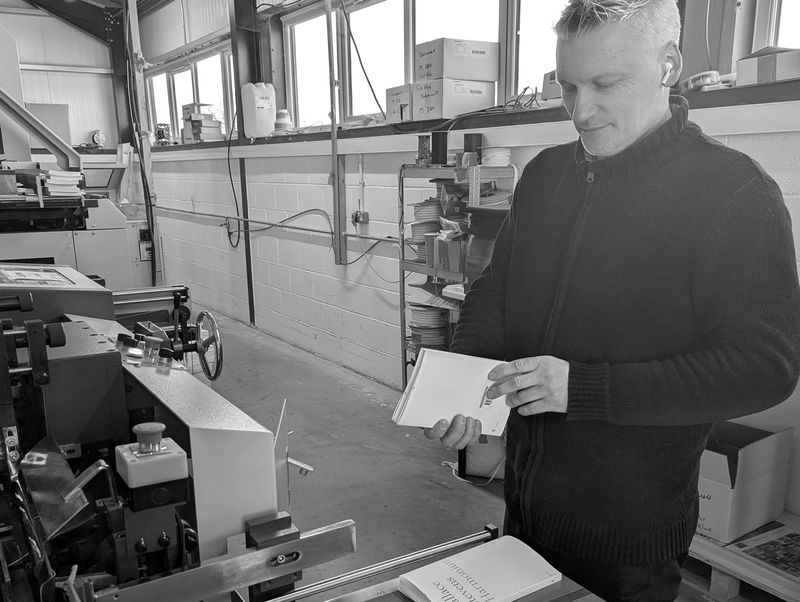
Short-run books being bound at our Exeter facility

Print on demand (POD) prints one book at a time on shared equipment, typically routed direct to a retail platform like Amazon. Short-run book printing runs a dedicated print job from 10 copies upward — you hold the books, you control the quality, you get a much lower per-copy cost.

For genuine single-copy retail fulfilment with no inventory, POD has its place. For everyone else — self-publishing authors, indie publishers, trade work, family editions, gift runs, academic monographs, event copies, library editions — short-run printing wins on cost, quality and flexibility. We're the short-run option.

The honest comparison

Print on demand vs
short-run book printing.

Six factors that matter when you're deciding how to print your book in the UK.

Factor Print on demand Short-run book printing
Minimum order One copy at a time. No minimum. 10 copies up — no setup fees, no minimum penalty. Pricing scales smoothly to 10,000+.
Per-copy cost (200pp A5 paperback) £8–£12 per copy regardless of how many you sell. ~£6 per copy at 10, ~£4 at 50, ~£2.50 at 250. The crossover is roughly 1 copy.
Print quality Consistent but generic. Standard paper, perfect-bound, limited cover finishing. Choose your paper stock (19 options), binding (perfect, PUR or thread-sewn), finishing (foil, emboss, dust jackets, ribbon markers).
Turnaround Per-order: typically 3–5 working days from order to ship for the buyer. No bulk capacity. 5–10 working days for the full run on paperback, 3–4 weeks on hardback. Fast Track available.
Inventory & control No inventory — books fulfilled as orders come in. You don’t hold stock and you don’t see the finished book before customers do. You hold the books. Free physical proof copy before the run. Full control of quality, distribution, signed copies, events, gifting.
Best for Long-tail Amazon backlist, low-volume retail integration where you can’t predict demand. Launches, local sales, events, trade fulfilment, family editions, gift runs, library copies, academic editions, and any quantity above ~3 copies.
When to choose which

Two valid approaches,
different jobs.

Use print on demand

POD makes sense when…

  • You're listing on Amazon or IngramSpark and want single-copy retail fulfilment with no inventory.
  • Your sales are slow, scattered, and unpredictable — long-tail backlist, niche genres.
  • You're testing a market and want to print only what sells.
  • You're outside the UK and need fulfilment in multiple territories.
  • You don't mind generic paper, standard perfect binding, and limited finishing options.
Use short-run book printing

Short-run wins when…

  • You're launching a book and want stock for events, signing copies, sending review copies, local bookshops.
  • You're a self-publishing author who'll sell direct or at events — cost per copy matters.
  • You want premium paper, thread-sewn binding, hardback construction or finishing options POD cannot do.
  • You're producing family histories, gift editions, academic monographs, corporate reports.
  • You need 10 to 10,000 copies and want them all printed in one quality-controlled run.
  • You want a free physical proof in your hands before the full print run starts.

For most self-publishing authors, the short-run route saves 50–75% per copy at any quantity above one and gives noticeably better print quality. POD's value is single-copy retail fulfilment — that's a real but narrow use case.

Short-run pricing

How short-run prices
stack against POD.

The first three rows show the same 200-page A5 paperback at three quantities. The crossover where POD becomes cheaper per copy is roughly 1 copy — even at 10 copies our short-run is comparable, and at 50+ it's substantially cheaper.

Format Specification Quantity Per copy
A5 paperback novel
200pp mono · perfect bound · 80gsm bookwove
10 £13.86per copy
A5 paperback novel
200pp mono · perfect bound · 80gsm bookwove
50 £4.08per copy
A5 paperback novel
200pp mono · perfect bound · 80gsm bookwove
250 £2.16per copy
A5 hardback novel
200pp mono · case bound · 80gsm bookwove
50 £7.08per copy

UK delivery and free physical proof included. Add 10–30% for premium cover materials, foil blocking or dust jackets. For your exact spec, see the book printing quote calculator or browse full UK book printing prices.
Honesty about scope

Why we don't offer
print on demand.

POD requires retail-platform integration — a warehouse system, shared equipment that prints on receipt of a single order, and integration with Amazon KDP, IngramSpark or similar. The unit economics, the equipment design and the operational model are all different from short-run book printing.

We're a real UK bookbindery: a Universe digital sheet-fed sewing machine, a Digibook case-binding line, foil-blocking presses, in-stock cloth and leather, 19 paper stocks held on-site. We thread-sew hardback books from 10 copies. POD providers don't do that — nobody offering true single-copy POD does, because the equipment is wrong for it. We're the part POD providers can't be, and they're the part we're not set up for. Visit our Exeter facility →

When POD is right

POD providers
we recommend.

If you genuinely need POD — single-copy fulfilment routed direct to a retail buyer — these are the providers we'd send you to. We don't earn anything from these recommendations; they're just honest pointers.

Amazon KDP

The dominant POD route for self-publishing authors selling on Amazon UK and US. Free to set up, integrates direct to Amazon's retail fulfilment.

Best for: Amazon-first sales, low-volume backlist.

IngramSpark

Wider distribution — gets your book into bookshops, libraries and global retail via Ingram's wholesale network. Setup fee, but broader reach than KDP alone.

Best for: Trade/bookshop distribution, global retail.

Lulu

Friendly to first-time authors, with a built-in cover designer and direct-to-consumer storefront. Higher per-copy cost than KDP but easier onboarding.

Best for: First-time self-publishers, direct sales.

How short-run works

Print 10, 100, or 10,000
all the same way.

1

Configure & quote

Use our quote calculator — size, paper, binding, finish, quantity. Live per-copy pricing, no email gate.

2

Upload PDF

Press-ready PDF of interior + cover. Our team checks files before press — free file check on every order.

3

Free physical proof

A printed proof copy dispatched within 2 working days. You hold the actual book before the run starts.

4

Full run printed

Your full quantity printed, bound and finished in-house at our Exeter facility. 5–10 working days for paperback, 3–4 weeks for hardback.

Print on demand FAQs

Questions about
POD vs short-run.

Not in the strict single-copy, retail-integrated sense. We are a short-run book printer — our minimum order is 10 copies, and we print, bind and dispatch your full run from one place. For genuine print on demand (one copy at a time, fulfilled as orders come in via Amazon, IngramSpark or a similar platform), we recommend Amazon KDP, IngramSpark or Lulu. For everyone else — most self-publishing authors, indie publishers, trade fulfilment and bulk gift orders — short-run printing from 10 copies is better value, better quality and more flexible than POD.
Print on demand prints one copy at a time on shared equipment, typically routed direct to a retail platform (Amazon, IngramSpark). Per-copy cost is high (£8–£15 for a typical paperback), quality is consistent but generic, and you have no inventory to manage. Short-run book printing runs a dedicated print job at 10 copies up — you hold the books, per-copy cost is much lower (£2–£5 for the same paperback at 50–250 copies), and you control quality, turnaround and finishing.
POD is the right choice when you genuinely need single-copy fulfilment routed direct to a retail buyer — typically Amazon or IngramSpark long-tail backlist titles where you cannot predict demand. It is also useful for very small unit-economics test prints. For most self-publishing authors with launch quantities, local sales, events, gift runs, library copies or trade fulfilment, short-run book printing is more cost-effective and higher quality.
POD requires retail-platform integration (Amazon KDP, IngramSpark) and shared-equipment fulfilment economics — a different business model from short-run book printing. We are a real UK bookbindery: thread-sewn binding from 10 copies, foil blocking, dust jackets, free physical proofs, in-house at our Exeter facility. We do the part POD does badly. POD providers do the part we are not set up for.
Ten copies. Unlike most short-run UK book printers, we do not push toward a 100 or 250 minimum. Our digital sheet-fed sewing machine and Canon/Ricoh presses make ten genuinely viable — pricing scales smoothly from 10 up to 10,000+ with no setup-cost cliff.
A typical 200-page A5 paperback through a POD provider is roughly £8–£12 per copy. The same book through us is around £6–£8 per copy at 10, £4 at 50, and £2.50 at 250. Hardback pricing follows a similar pattern: significantly cheaper per copy at any quantity above one. The crossover where POD might be cheaper is genuinely a single copy — and even then quality is typically lower.
You can order one or two as a proof or single-copy gift, yes. Per-copy cost will be high (press setup is the same regardless of run length) but for a one-off it is straightforward. Most customers ordering one copy do so as a proof before committing to a short run — in which case the proof is included free as part of the standard short-run order.
For genuine print on demand we suggest Amazon KDP (for retail integration with Amazon UK and US), IngramSpark (for wider trade distribution to bookshops and libraries) or Lulu (for global low-volume retail). All three are well-established. For everything else — proper print quality, thread-sewn binding, premium materials, dependable turnaround, UK-based bindery — that is where we come in.

More on book printing generally? See our book printing services hub or 73-question book printing FAQ.

Ready to price
your short run?

Get an instant online quote — no account required. From 10 copies up, with the same quality and proof process whether you're printing 10 or 10,000.