Thread sewn binding is the strongest, longest-lasting way to bind a book. Pages are folded into sections, stitched through their folds with thread, and the sections sewn to one another to form a single solid book block. Glue plays only a supporting role, sealing the spine and attaching the cover, so the strain of every opening is carried by hundreds of stitches, not a film of adhesive.
Thread sewing is a long-established way to make a durable book. Stitched sections support repeated use and help the pages open more easily. The finished book is not completely lay-flat, and its opening depends on the paper, page count and construction.
Thread sewn, section sewn or Smyth sewn, what's the difference?
Nothing: they're three names for the same method. Section sewn describes what happens (sections sewn together); Smyth sewn comes from the Smyth Manufacturing Company, whose machines made the technique industrial in the 1880s; thread sewn is the plainest description of all. If a printer quotes you any of the three, you're being offered the same thing, and it's the right thing to ask for.
How thread sewn binding works
The pages are printed, then folded into groups of 8 to 32 pages called signatures (or sections). Each signature is stitched along its fold, the thread passing through every page several times, and then sewn to its neighbours, building up the complete book block.
The sewn block gets a thin layer of adhesive along the spine to seal and square it. For a paperback, the cover is then drawn on directly; for a case-bound hardback, folded endpapers are attached instead and the block is cased into rigid boards.
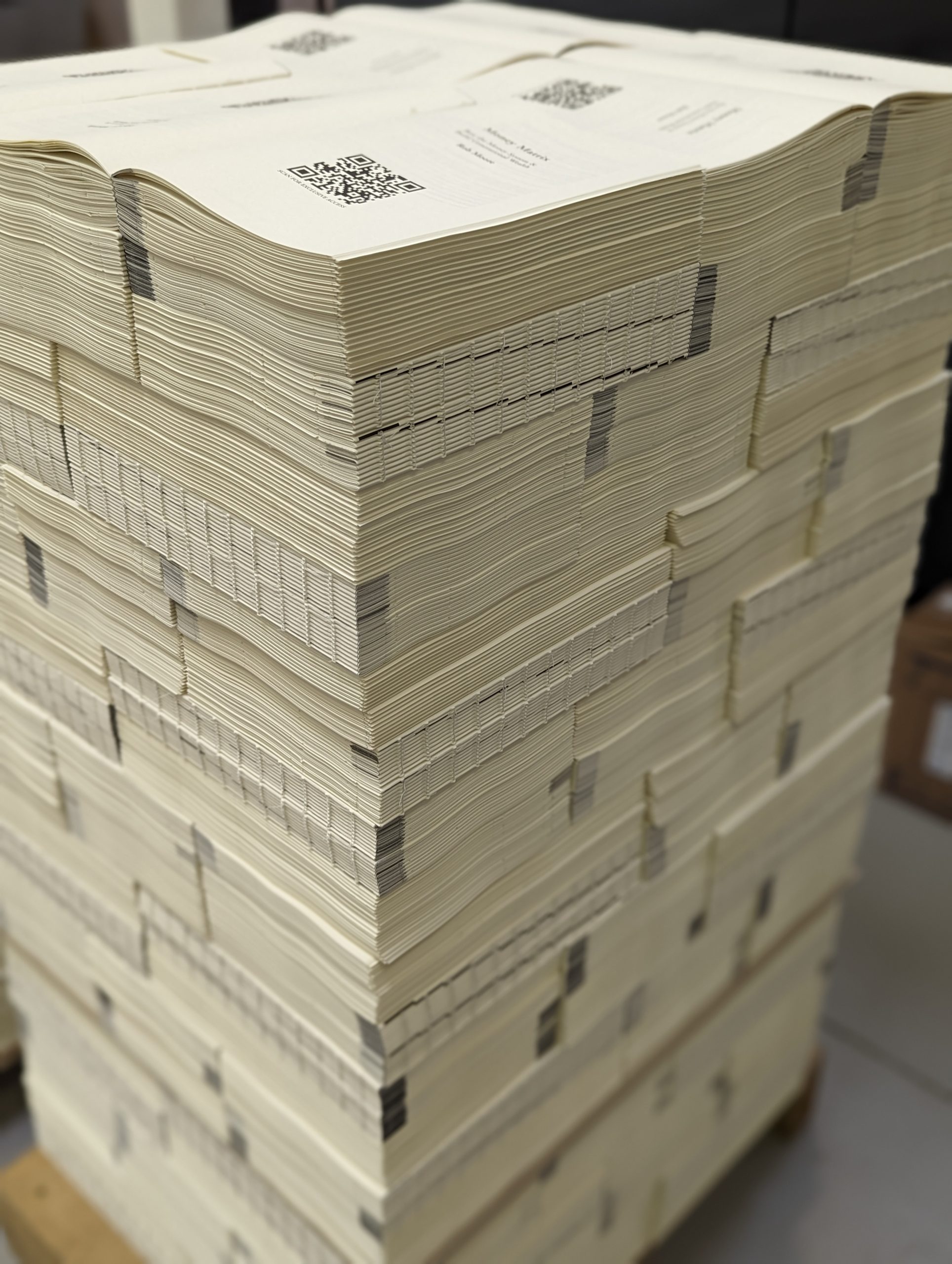
Scroll on to watch the method in action, the demo below this article sews four signatures onto a spine, stitch by stitch, exactly the way the machine does it.
Sewn books from digitally printed sheets, in runs as small as 10
Traditionally, thread sewing belonged to long litho runs: print large sheets, fold, gather, sew. We do it differently. Our Universe sewing line takes digitally printed flat sheets one at a time, folds and gathers them into sections, and sews each section as it goes, which means a sewn book block no longer needs a warehouse-scale print run to justify itself.
In practice: sewn paperbacks from just 10 copies and sewn hardbacks from 25. Choose a thread-sewn block for either format; glued hardbacks and perfect-bound paperbacks are also available. Compare the binding options in the calculator to see how sewing changes the price of your book.
Why choose thread sewing?
- Opens more easily: ideal for images that span two pages, recipes followed on a kitchen counter, scores on a music stand, manuals beside a machine.
- Pages cannot fall out, every leaf is stitched in as part of a section; removing one means cutting it.
- Survives heavy use: opening stress is shared across the whole spine instead of concentrating at a glue line, so textbooks and references stay tight for decades.
- Tamper-evident: a page can't be removed without visible damage, which is why sewn binding is used for registers and sensitive documents.
- Built for generations: the binding lasts as long as the paper does, which is why sewn books are the choice for editions meant to be kept and passed on.
Thread sewn vs PUR vs perfect binding
The three main ways to hold a book together, strongest first:
- Thread sewing: stitched sections for easier opening and repeated use; not a completely lay-flat construction
- PUR binding: polyurethane reactive adhesive; the strongest glued binding
- Perfect binding: standard EVA hot-melt adhesive; fine for typical paperbacks
| Thread sewn | PUR bound | Perfect bound (EVA) | |
|---|---|---|---|
| Pages held by | Thread stitches + glue | Polyurethane adhesive | EVA hot-melt adhesive |
| Opening | Easier opening from sewn sections; not completely lay-flat | Flexible glued spine; not completely lay-flat | Glued spine; not completely lay-flat |
| Page security | Cannot pull out | Very hard to pull out | Can loosen with heavy use |
| Lifespan | Generations | Many years | Years; glue can embrittle |
| Coated / heavy stocks | Excellent | Good | Poor |
| Cost | Highest | Middle | Lowest |
Glued bindings have their place, a novel read twice doesn't need stitches. The honest rule: the harder a book will be used, and the longer it should last, the further up the list you should buy.
How to tell if a book is thread sewn
Pick up any hardback and open it near the middle. If you can see fine stitches running down the centre fold of the section (in the gutter, where the pages meet) it's sewn. Look at the top of the spine with the book shut and you'll often see the gentle scallop of gathered sections rather than one flat glued edge. Sewn sections usually allow easier opening, while the paper, extent and cover construction also affect how the finished book behaves. It's a thirty-second check that tells you more about a book's quality than anything on the cover.
What we sew
Hardbacks: choose a thread-sewn block for your hardback book; glued blocks are also available. See the complete guide to case binding for how the sewn block becomes a finished hardback.
Paperbacks: thread sewing is an optional upgrade on any paperback we print. Worth it when your book will live a hard life or benefits from easier opening: cookbooks, workbooks, manuals, music, art books with cross-page spreads, landscape formats, and anything printed on heavy coated stock.