Five binding methods produced entirely in-house at our Exeter facility — from short-run thread-sewn hardbacks to PUR-bound paperbacks and saddle-stitched booklets. Every binding handled by our own team, from just 10 copies upward. No outsourcing. Most of it is short-run book printing — 10 to 500 copies.
Each method below has its own deep-dive page covering process, durability, suitable papers and typical applications. If you’re unsure which fits, give us a call — we’ll talk you through which method gives you the look, durability and price-point you’re after.
Hardback books with rigid 2.75mm board covers wrapped in printed paper, cloth or leather. The most durable, premium binding we offer — built for long-term preservation.
Pages physically sewn together with thread before binding. The strongest, longest-lasting binding available — and books open completely flat. From just 10 copies.
Polyurethane reactive adhesive. Stronger and more flexible than standard perfect binding — recommended for coated paper, heavy-use books and titles that need to lie flat.
EVA hot-melt adhesive holds pages directly into a wraparound cover. The classic trade-paperback method — cost-effective, professional and ideal for novels, manuals and catalogues.
Folded sheets stapled along the spine. The most economical binding for shorter publications — magazines, brochures and event programmes.
A practical guide based on what your book is for, who reads it, and how long it needs to last. Pick the closest match — or call us and we’ll talk you through it.
Maximum durability and visual presence: thread-sewn pages bound into rigid 2.75mm boards with cloth, leather or printed paper covers. Decades of regular use without splitting.
Most economical option for paperbacks. Hot-melt EVA adhesive holds pages directly into a wraparound card cover. The default choice for novels, manuals and event programmes.
Polyurethane reactive adhesive bonds far better to coated paper than EVA, and stays flexible over many openings. Recommended for books that will see heavy daily use.
Pages physically sewn together with thread before being bound, in either a hardback or paperback cover. The strongest binding available — and the book opens fully flat.
Beyond the binding method itself, the look and feel of a finished book comes from materials — cover cloth, board weight, foil colour, ribbon markers and headbands. Everything below is stocked at our Exeter facility and applied in-house.
All five rows below are the same book — A5, 200pp mono, 80gsm opaque paper — only the binding changes. That isolates the cost differential between binding methods so you can compare like for like. For your actual spec, the instant calculator takes under a minute.
| Binding method | Detail | Quantity | Per copy |
|---|---|---|---|
Perfect bound (paperback) |
EVA hot-melt adhesive · economical · most paperbacks |
100 | £2.88per copy |
PUR bound (paperback) |
Polyurethane reactive · stronger · coated paper / lay-flat |
100 | £2.98per copy |
Thread-sewn (paperback) |
Pages physically sewn · strongest paperback binding |
100 | £5.35per copy |
Case bound (hardback) |
Thread-sewn block · 2.75mm board · printed paper case |
100 | £4.88per copy |
Case bound (low quantity) |
Same hardback spec at 50 copies · setup cost shows |
50 | £7.08per copy |
Prices include UK delivery and exclude VAT. The two case-bound rows show how setup costs spread — the same hardback at 100 copies is markedly cheaper per copy than at 50. Get an exact quote for your spec →
Imprint Digital offers a trade binding service for UK publishers, print management companies and design studios. If your sheets have already been printed elsewhere — or if you handle printing in-house but lack binding capacity — send us your work and we’ll case bind, thread-sew, PUR bind, perfect bind or saddle-stitch on your behalf.
Typical applications: small-edition art books, finishing for trade publishers, overflow capacity during peak periods, or specialist binding (thread-sewn case binding) on jobs printed on a digital or web press elsewhere. Trade pricing is competitive and we work to your project deadline rather than ours.
For a trade binding quote, contact us directly with the details opposite.
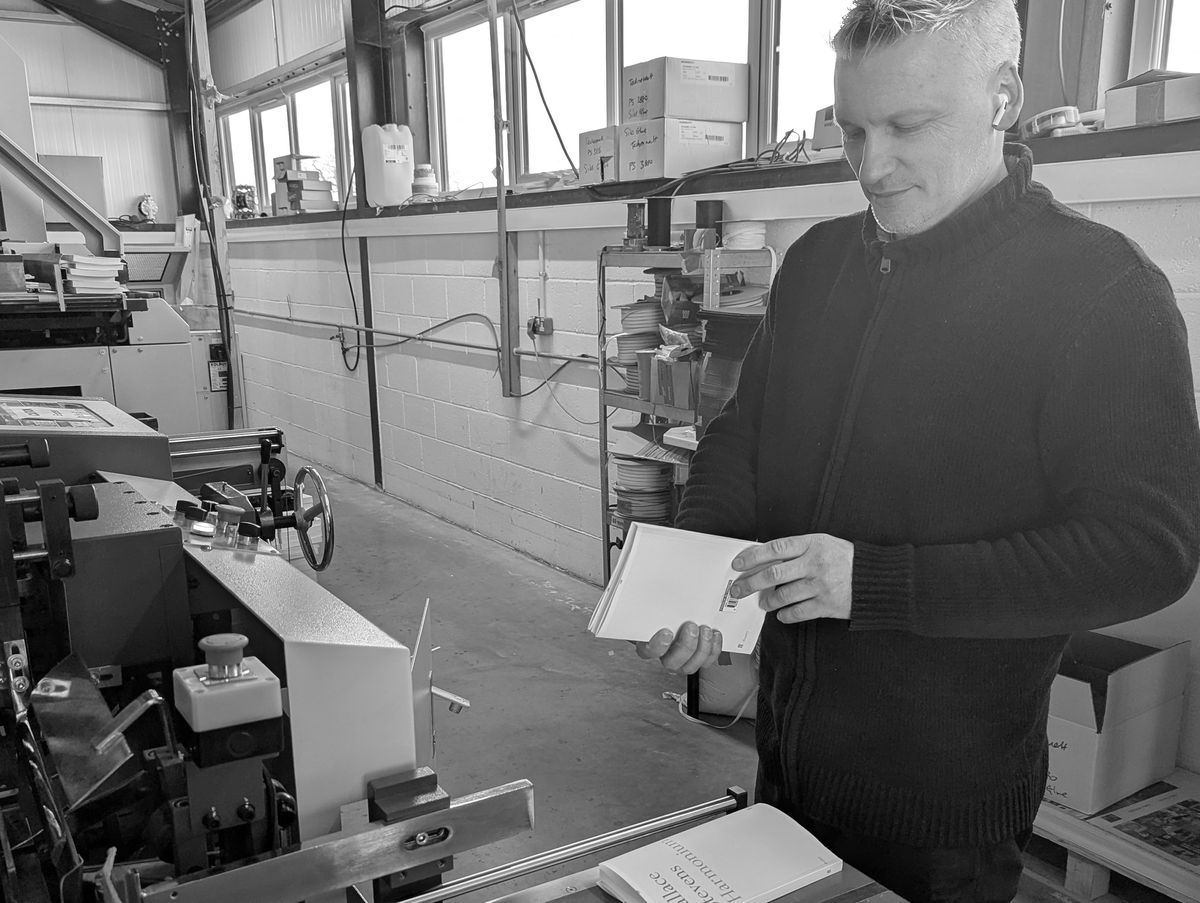
Our Universe digital sheet-fed sewing machine lets us thread-sew at short-run quantities — the same binding you’d find on a Penguin Modern Classic, available from just ten copies. Most short-run printers can’t do this at all.
Case binding, thread-sewing, PUR, perfect binding and saddle-stitching all happen on our own lines at our Exeter facility. No outsourcing means tighter quality control, faster turnarounds, and a single point of contact for your project.
Wibalin and buckram cloths, leather and vegan covers, headbands and tail-bands, marker ribbons and foil-blocking — all stocked and applied in-house. Genuine specification choice rather than a take-it-or-leave-it default.
An honest comparison of how Imprint Digital differs from typical UK book binders. We don’t name names — just describe what’s common across the industry.
| Aspect | Most UK book binders | Imprint Digital |
|---|---|---|
| Operation type | Most UK binders are small craft shops, often part-time or single-person operations — tradition over scale. | A 30-year commercial bindery with industrial equipment (Universe sewing machine, Digibook line) plus traditional finishing skills. |
| Minimum quantity | Either single-copy bespoke (high per-copy cost) or 1,000+ trade runs. Awkward gap in between. | From 10 copies, no setup fees. Per-copy pricing scales smoothly all the way to 10,000+. |
| Thread-sewn at short-run | Reserved for bespoke single-copy work or trade runs of 1,000+. Not typically available in between. | Standard from 10 copies on our Universe digital sheet-fed sewing machine. |
| Combined print & bind | Most binders don’t print — you supply pre-printed sheets. Coordination across two suppliers. | Print and bind in the same facility. Faster turnaround, fewer handovers, single point of contact. |
| Materials & finishes | Variable — depends on the bindery’s in-stock materials and tooling. | Wibalin, buckram, leather, vegan covers, foil colours, headbands, ribbons — all stocked on-site. |
| Turnaround | 2–6 weeks typical for short-run binding work. | 3–4 weeks standard for hardback. Fast Track 2 weeks (+25%) on most jobs. |
A handful of the most common binding-specific questions. For our full FAQ across design, printing and shipping see the FAQ page, or for long-form deep-dives see Printing FAQ.
What types of book binding do you offer?
Five methods, all produced in-house: case binding (hardback), thread-sewn, PUR perfect binding, EVA perfect binding, and saddle-stitching. We do not outsource any binding work — every book is bound at our Exeter facility.
What is the difference between PUR and perfect binding?
Both bind pages directly into a wraparound paperback cover with hot-melt adhesive, but PUR uses a Polyurethane Reactive glue that is significantly stronger and more flexible than the EVA used in standard perfect binding. PUR is recommended for coated paper, lay-flat openings, and books that will see heavy use.
What is thread-sewn binding?
The pages of the book are physically sewn together with thread before being bound into the cover. It is the strongest, longest-lasting binding method available, and the books open completely flat. Found on premium hardbacks like Penguin Modern Classics — and we offer it from just 10 copies.
How much does book binding cost?
For a 200-page A5 book at 100 copies, expect roughly £3.30 per copy for perfect binding, £3.40 for PUR, £6.00 for a thread-sewn paperback, and £5.30 for a thread-sewn case-bound hardback. Our pricing table below shows real per-copy figures from the live calculator.
Can you bind books I have already printed elsewhere?
Yes — we offer a trade binding service for pre-printed sheets, subject to specification check. Please contact us with details of your printed sheets (paper stock, page count, quantity, dimensions), the binding method you need, and any cover materials. We will quote separately for the binding-only work.
What is the minimum quantity for case binding?
Ten copies. Most short-run printers cannot economically run hardbacks below several hundred — our digital sheet-fed sewing machine and short-run case-making line let us produce thread-sewn case-bound books from just ten.
Which binding method is most durable?
Thread-sewn case binding is the most durable method we offer — pages are physically sewn together before being bound into rigid 2.75mm board covers. Used on premium hardbacks like Penguin Modern Classics, this binding lasts decades with regular use. Thread-sewn paperback is the second most durable.
Do you offer foil blocking and embossing?
Yes. We have foil blocking, embossing, debossing and spot UV available in-house, applied directly onto Wibalin cloth, buckram, leather or printed paper covers. Foil colours include gold, silver, copper, white and various metallics. Specify on your quote or get in touch to discuss bespoke finishing options.
What is the difference between case binding and perfect binding?
Case binding produces a hardback book with rigid board covers wrapped in cloth, leather or printed paper, with pages typically thread-sewn before binding. Perfect binding produces a paperback with pages glued directly into a flexible card cover. Case binding is more durable and premium-looking; perfect binding is cheaper and faster.
Do you offer trade binding for publishers and print companies?
Yes — we regularly handle trade binding for UK publishers, print management companies and design studios. Send us your printed sheets and we will case bind, thread-sew, PUR bind or saddle-stitch on your behalf. Trade pricing available; please contact us with project details for a quote.
Live online pricing in under a minute — no account required. Or order a free sample pack to see and feel our binding work first-hand before you commit.