Updated June 2026
Wondering how much it costs to print a book? Whether you're self-publishing, printing a business book, or producing a novel, this guide breaks down exact costs, compares printing methods, and shows you how to save money.
Knowing these costs is key to bringing your book to market and at least breaking even. A typical paperback novel sits in the £1.50, £4 range; a thread-sewn hardback with foil and dust jacket can exceed £25 per copy. The factor that moves price the most is quantity, print 50 copies and you pay setup-heavy per-copy prices; print 1,000 and the per-copy price can drop by half or more.
Whether you're a self-published author, a business, or a publishing house, understanding book printing costs helps you make informed decisions and maximise your budget.
In this guide, we'll cover:
- Real UK Book Printing Prices (2026 examples)
- Book Printing Cost Comparison
- Factors That Influence Printing Costs
- Printing Methods: Digital vs. Offset vs. POD
- Hidden Costs to Consider
- How to Reduce Printing Costs
- Which Printing Option is Best?
We'll break down typical expenses, look at different printing methods, and highlight any hidden costs you might encounter.
We'll also discuss print-on-demand services and share tips on printing a hardcover book more affordably. By the end, you'll clearly understand what to consider when requesting a book printing quote.
Here's a general pricing range for UK book printers:
| Book Type | Low-End Cost (per copy) | High-End Cost (per copy) |
|---|---|---|
| Paperback (100 copies, 200 pages, black & white) | £1.50, £3.50 | £5.00, £8.00 |
| Hardcover (50 copies, 200 pages, black & white) | £4.50, £6.50 | £10.00, £25.00 |
| Colour Paperback (100 copies, 200 pages) | £4.00, £7.00 | £10.00, £20.00 |
| Print-on-Demand (1-5 copies, 200 pages) | £6.00, £10.00 | £12.00, £25.00 |
The more you print, the cheaper the per-book cost.
Real UK book printing prices (2026 examples)
The table below shows real per-copy prices from Imprint Digital's online calculator for six common book specs at typical short-run quantities. All prices exclude UK delivery, which is calculated at checkout. Printed books are zero-rated. VAT at 20% is added to delivery, and to notebooks, diaries and journals. The same calculator handles any combination of size, page count, paper, binding and quantity, these are starting points, not the only options.
| Format | Specification | Quantity | Per copy |
|---|---|---|---|
| A5 paperback novel | 200pp mono · perfect bound · 80gsm opaque | 200 | £2.66 |
| B-format paperback | 250pp mono · perfect bound · 80gsm cream | 100 | £4.18 |
| A4 colour paperback | 100pp full colour · PUR bound · 100gsm opaque | 250 | £8.46 |
| A5 hardback | 250pp mono · thread-sewn case bound · 80gsm opaque | 50 | £8.03 |
| Royal hardback | 300pp mono · thread-sewn case bound · 80gsm opaque | 100 | £6.26 |
| A4 colour hardback | 200pp colour · thread-sewn case bound · 100gsm opaque | 50 | £21.41 |
A few patterns to notice in the table above. First, hardback's per-copy price falls fast with quantity, a Royal hardback at 100 copies (£6.26) costs less per copy than an A5 hardback at 50 (£8.03), even though the bigger format uses more paper. That's the case-binding setup cost being amortised across more copies. Second, full colour roughly doubles the per-copy price compared to mono on the same format. Third, smaller formats (A5, B-format) print more economically than A4 because more pages fit on each press sheet.
For the comprehensive UK book printing prices page across every quantity tier, our summary pricing examples on the services page, or your exact spec via the book printing quote calculator, pick whichever fits your need.
Book printing cost comparison (UK-based printers)
We compared pricing from major UK book printing companies to compare real-world costs.
All costs are based on a 200-page A5 paperback (black & white, 100 copies, standard bookwove paper and thread-sewn hardbacks):
| Printer | Paperback (200 pages, 100 copies) | Hardback (200 pages, 50 copies) | Notes |
| Imprint Digital | £295.00 | £497.50 | Thread-sewn, FSC paper, fast turnaround |
| Book Printing UK | £449.16 | £528.88 | Additional services, hardbacks are not sewn. |
| Mixam | £555.00 | £426.50 | Print management company, not thread sewn |
| Print2Demand | £459.00 | £664.50 | Quick calculator, easy to navigate website |
| Catford Print | £453.06 | £541.85 | Quick calculator, multiple print services |
| InstantPrint | £455.00 | N/A | Lots of products and a range of services |
Note: Prices change frequently, and additional costs (e.g., shipping, proofs) may apply.
Imprint Digital are the only short-run book printing company that can offer thread-sewn hardback books at a competitive price starting at 25 copies.
Factors That Influence Book Printing Costs
Several key elements influence the final price of a printed book, including paper quality, binding options, the number of copies printed, and the choice between colour and black-and-white printing. Understanding how these different elements affect the price and look of your book is essential.
1. Paper Type & Quality
Choosing the right paper stock is critical, as it affects cost, durability, and the overall reading experience. Here's a breakdown of common paper types used in book printing:
- 80gsm opaque paper, A cost-effective and widely used option for text-heavy books. Provides good readability while keeping production costs low.
- 100-120gsm bookwove, A slightly heavier and higher-quality paper suitable for general fiction and non-fiction. This is a popular choice for premium-feeling books.
- 150-170gsm coated (gloss/silk/matt), Ideal for books with illustrations, photography, or high-quality visuals. Coated options provide enhanced colour vibrancy and crisp images.
- Recycled or FSC-certified paper, A sustainable alternative for eco-conscious authors and publishers. While slightly more expensive, it aligns with environmental standards and consumer preferences.
Balancing Cost & Print Quality
For self-publishers or businesses printing in bulk, it's essential to balance quality and cost-effectiveness:
- A cheap booklet can use 80gsm standard paper.
- A typical novel benefits from 80gsm bookwove for improved opacity and durability.
- High-quality photography books require coated stocks (150gsm-170gsm) for image clarity and colour depth.
2. Binding Type
Different bookbinding methods impact both durability and price:
| Binding Type | Best For | Cost Range |
| Perfect Binding | Most paperbacks | ££ |
| Saddle Stitching | Small booklets (64 pages max) | £ |
| Hardcover (Case Bound) | High-end books, durability | £££ |
Perfect binding is the most common and cost-effective option for paperback books. It involves gluing the pages to a cardstock cover, usually 240 to 260gsm. Saddle stitching uses staples to hold the pages together, making it very economical but less durable and suitable only for books with 64 pages or fewer. Hardcover binding, also known as case binding, is the most expensive but offers a luxurious feel with sewn pages and premium cover options.
Finishing touches, such as cover lamination or UV coating, add to the overall cost but provide additional protection and enhance the book's appearance. Case wrapping and glueing over a thick, rigid board for hardcover books contribute to higher expenses than faster, less labour-intensive paperback production. Our hardback books offer a choice of economical glued binding or premium thread-sewn binding.
How much does it cost to print a hardback book specifically?
Hardback printing is more involved than paperback. Pages are typically thread-sewn into signatures, glued to a fabric or paper-cased rigid board, and finished with foil blocking or printed dust jackets. That production complexity raises the per-copy price, but spreads quickly across larger runs.
For a 200-page UK hardback in 2026, expect roughly:
- 50 copies, mono, A5: £7, £10 per copy
- 50 copies, mono, Royal: £8, £12 per copy
- 100 copies, mono, A5: £5, £8 per copy
- 250 copies, mono, A5: £4, £6 per copy
- 500+ copies, mono, A5: £3, £5 per copy
Premium finishes: foil blocking on the spine and front, a printed dust jacket, ribbon markers, head-and-tail bands, typically add £0.50, £3 per copy depending on choices. Coffee-table books and large-format photography books printed on coated paper push the upper end of the range; expect £15, £25 per copy for short runs.
We offer thread-sewn hardback book printing from 25 copies. Glued binding is a lower-cost alternative. See our book binding services to compare the construction and finishing options.
3. Print Run Size (How Many Copies?)
The more books you print, the lower your per-unit cost. For example:
- 100 copies = £2.50 per book
- 500 copies = £1.50 per book
- 1,000+ copies = £1.00 per book
For short runs, digital printing is more affordable. Offset printing becomes cheaper for larger orders (1,000+ copies).
Generally, the more copies you produce at once, the lower the cost per unit. For example, printing 2,000 books will result in a lower unit cost than printing 200. This is because larger quantities are often matched with more cost-effective production methods. Digital printing is advantageous for short runs due to minimal setup times resulting in a lower makeready cost, while offset printing becomes more economical for longer runs due to the extra time needed to set the job up, producing plates etc.
4. Colour vs. Black & White
- Black & White: £1.50, £4.00 per book
- Full Colour: £4.00, £15.00 per book
Mixing black & white with a few colour pages can help reduce costs.
Colour printing traditionally costs more because it requires four toner colours (cyan, magenta, yellow, and black) to produce the full spectrum of colours. Black-and-white printing uses only black toner, making it less expensive. Advances in printing technology have made colour printing more affordable, but it still tends to be pricier than black and white. Colour printing is essential for books that feature vibrant illustrations, photographs, or when visual appeal is a critical factor.
To optimise costs, we have the option to mix colour and black-and-white pages within the same book. This approach allows you to include colourful illustrations or graphics where necessary while keeping the text sections more economical. For example, you can choose to have colour pages throughout the book or insert colour plate sections printed on different paper stock.
Printing Methods: Digital vs. Offset vs. Print-on-Demand
The printing method you choose plays a crucial role in determining both the cost and the quality of your final product. Whether you're an author a publisher or a business printing marketing material, it's essential to understand your options to ensure your book meets your expectations, both in appearance and budget. Offset vs digital printing comes up in conversation multiple times due to their price differences on large runs, lets have a look at each printing option in more detail.
| Method | Best For | Pros | Cons |
| Digital Printing | Short runs (10-500 copies) | Fast turnaround, flexible | Higher per-book cost |
| Offset Printing | Large runs (1,000+ copies) | Lower cost per unit | High setup cost |
| Print-on-Demand (POD) | Single copies | No inventory needed | Most expensive per unit |
Digital Printing
Digital printing has transformed the book printing industry by offering an affordable option for small print runs. This process sends digital files (PDF) directly to the press using software such as Fiery or Prisma from Canon. This does away with the need for traditional printing plates which greatly reduces the make-ready time.
One of the biggest advantages of digital printing is the flexibility it offers. You can print any number of books, from a single copy for proofing to several thousand, without facing high setup costs. This makes it perfect for self-published authors or those wanting to test the waters with a new title. Plus, making changes or updates is easy. If after the single proof copy you spot any mistakes, you can send a new print file with only a small file amendment charge.
Offset Printing
Offset printing remains the go-to method for producing large volumes of books, usually several thousand copies or more. This technique uses metal plates to transfer ink onto paper via a rubber cylinder.
The main advantage of offset printing is its cost-effectiveness for big print runs. While the initial setup is more expensive because of the need to create printing plates, the cost per book drops significantly as you print more copies. This makes offset printing the preferred choice for publishers planning to sell thousands of books.
Print-on-Demand
Print-on-demand (POD) is another digital printing method. The books are printed in the same way as any other digital print run with the advantage of more automation, allowing the setup and single copies to be produced without large setup times.
POD services usually integrate with a distribution centre linked to an online bookstore. When a customer places an order, the book is printed and shipped directly to them. This model minimises financial risk because there's no need to predict how many copies will sell; you print exactly what is ordered.
Compare current POD and batch-printing quotes for the same specification. Include delivery and any platform or distribution fees, then assess the full cost against expected sales and storage needs. Check samples and the available paper, size, binding and finish before deciding.
Each method has its strengths and weaknesses, and the best choice depends on factors such as print run, book size, budget, time constraints, and desired finishes.
Hidden Costs to Consider
Some printing expenses are often overlooked, leading to unexpected costs. Here's what to watch out for:
1. Shipping & Handling Fees, Can add £0.50-£2.00 per book
Shipping costs vary based on the book's weight, size, and destination. It's important to get a shipping estimate before confirming your order. For print-on-demand (POD) services, shipping fees are typically included in the final price, but if you're handling your own distribution, don't forget to factor in packaging materials, postage, and potential bulk shipping discounts.
International shipping can further increase costs, especially when shipping from the UK to Europe due to customs duties and VAT regulations.
2. Proof Copies & Revisions, £10-£100 per proof
Proof copies are essential to ensure print quality before committing to a full run. However, revisions can add extra costs. Some printers charge for each file update, which can become expensive if changes are needed across multiple formats (e.g., hardcover, paperback, and ebook).
For instance, fixing a small typo across different book formats can incur multiple charges. To reduce revision costs, thoroughly proofread and finalise your files before submission. Some printers may waive minor revision fees for large orders, so it's worth negotiating if you're printing in bulk.
3. Errors & Returns
If the printer makes a mistake, they typically cover the cost of reprinting. However, if an error occurs due to an issue on your end, such as incorrect formatting or last-minute design changes, you may need to cover the cost of a reprint.
To avoid this:
- Double-check your manuscript before submission.
- Request digital proofs to review layout and design.
- Confirm file specifications with your printer before finalising the print run.
Additionally, some printers have overage or underage policies, meaning you may receive slightly more or fewer copies than ordered due to production variances. Be sure to check if this affects your final cost.
How to Reduce Printing Costs
- Print in Bulk, The more you print, the cheaper it gets per book.
- Choose Black & White, Only use colour where absolutely necessary.
- Optimise Paper Choice, Balance cost and quality (e.g., bookwove vs. coated).
- Consider Alternative Binding, Perfect binding is cheaper than case-bound hardcovers.
- Use Print-on-Demand for Testing, If unsure about demand, start small.
Which Printing Option is Best for You?
- Short runs (10-2,000 copies)? Use digital printing for flexibility.
- Large orders (5,000+ copies)? Offset printing is cheaper per unit.
- Want to avoid inventory? Print-on-demand (POD) is best, but it is more expensive per book.
If you're ready to print your book, use our instant book printing quote tool to get a price in seconds!
How It Works:
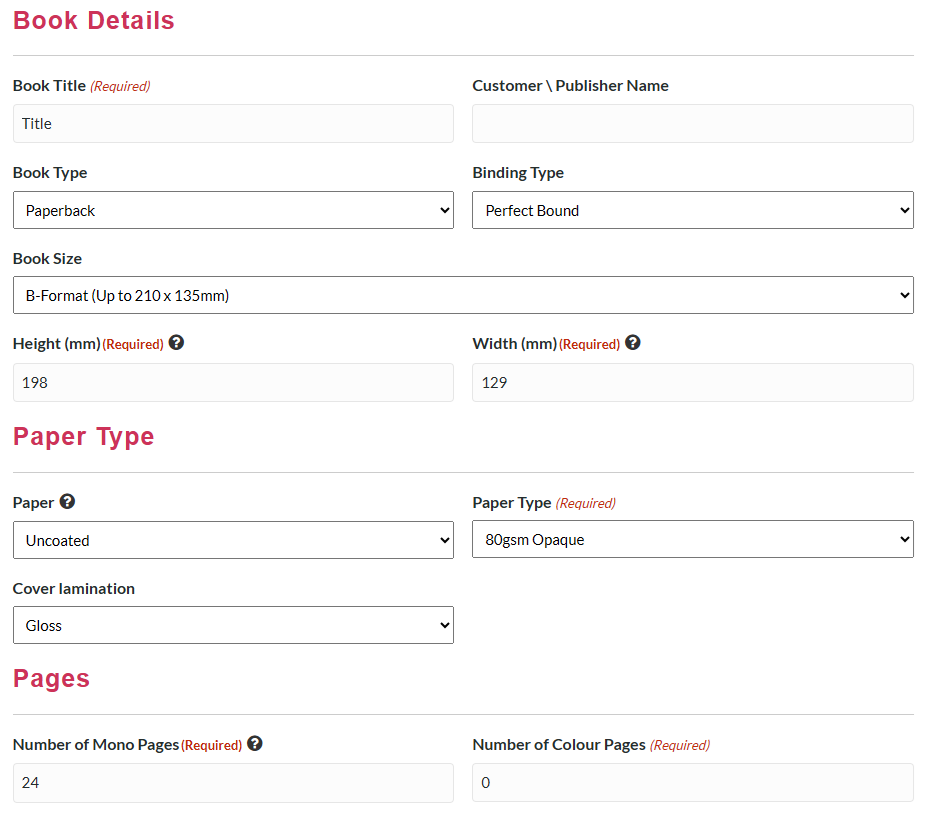
- Input Your Book Specifications: Enter details such as book size, number of pages, binding type (e.g., perfect binding or hardcover), and whether you need colour or black-and-white printing.
- Choose Paper Options: Select the type of paper for the interior and cover, ranging from standard 80gsm to premium coated stocks.
- Select Quantity: The tool will calculate costs for your desired print run, showing you how the price changes for larger or smaller quantities.
- Get Your Quote: Instantly receive a breakdown of the estimated costs and any applicable finishing options like lamination or UV coating.
Why Use Our Online Quote Tool?
- Fast and Convenient: Get real-time pricing without waiting for manual quotes.
- Customisable Options: Tailor your quote to match the specific needs of your book, from paper type to finishing touches.
Frequently asked questions
How much does it cost to print 100 copies of a paperback book?
For a standard 200-page A5 paperback at 100 copies in the UK, expect roughly £3 to £5 per copy on perfect binding with 80gsm opaque paper. Mono interior is cheapest; full-colour pages roughly double the per-copy price. Imprint Digital's instant calculator gives you an exact figure for your spec.
How much does it cost to print a hardback book?
UK hardback printing typically costs £6 to £12 per copy for a 200-page mono hardback at 50 to 250 copies, falling to £3 to £5 per copy at 500+. Premium finishes (foil blocking, dust jacket, ribbon markers) add £0.50 to £3 per copy. Coffee-table colour hardbacks at short runs reach £15 to £25 per copy. See our hardback printing service.
What is the cheapest way to print a book in the UK?
The cheapest UK option is short-run digital printing on a perfect-bound paperback with mono interior, 80gsm opaque paper, and a print run of 250+ copies. At those settings, per-copy prices fall under £2.50. Saddle-stitched booklets (under 64 pages) are even cheaper but only work for short content.
How much does it cost to print a colour book?
Full-colour book printing in the UK typically costs £4 to £15 per copy depending on quantity, page count and paper. Colour pages roughly double the cost per page versus mono. To save money, consider mixing mono text pages with a smaller colour-plate section, this hybrid approach is common in non-fiction and photography books.
Is it cheaper to print a book in the UK or abroad?
Compare current quotes for the same paper, binding, quantity and finish. For an overseas quote, also check shipping, import charges, delivery dates, proof arrangements and how problems would be resolved. Assess the full delivered cost and samples before deciding where to print.
How much does a book proof cost?
UK printers charge £10 to £100 per proof copy depending on the spec and printer. At Imprint Digital a digital proof is free, and a printed proof can be added as an optional extra. Always check what a printer includes before placing an order.
Does book printing get cheaper in bulk?
Yes, significantly. A 100-copy run might cost £3 per copy; the same book at 500 copies typically falls to £1.50 to £2 per copy; at 1,000+ copies it can drop below £1.20. The setup cost (file checks, plate setup for offset, colour calibration) is fixed, so per-copy costs fall as quantity rises.
What is the minimum cost to print a book?
At Imprint Digital, the minimum is 10 copies for paperbacks and 25 copies for hardbacks. The per-copy price is highest at the lowest quantity, because setup costs spread across fewer books, so the same 200-page A5 paperback costs noticeably more each at 25 copies than at 250. Our calculator prices your exact spec at every run length.
How much does it cost to print 1,000 books?
For 1,000 copies of a 200-page A5 paperback in the UK, expect roughly £1.20 to £2.50 per copy (£1,200 to £2,500 total). Hardbacks at 1,000 copies typically run £3 to £6 per copy. At this volume, offset printing usually becomes competitive with digital, so it's worth getting quotes on both methods.
Why is hardback book printing more expensive than paperback?
Hardback production involves more steps: pages are usually thread-sewn into signatures (rather than glued like a paperback), wrapped around a rigid 2.75mm board, and case-bound with cloth or printed paper. Each step adds labour and materials. Premium finishes like foil blocking, dust jackets, and ribbon markers add further cost.