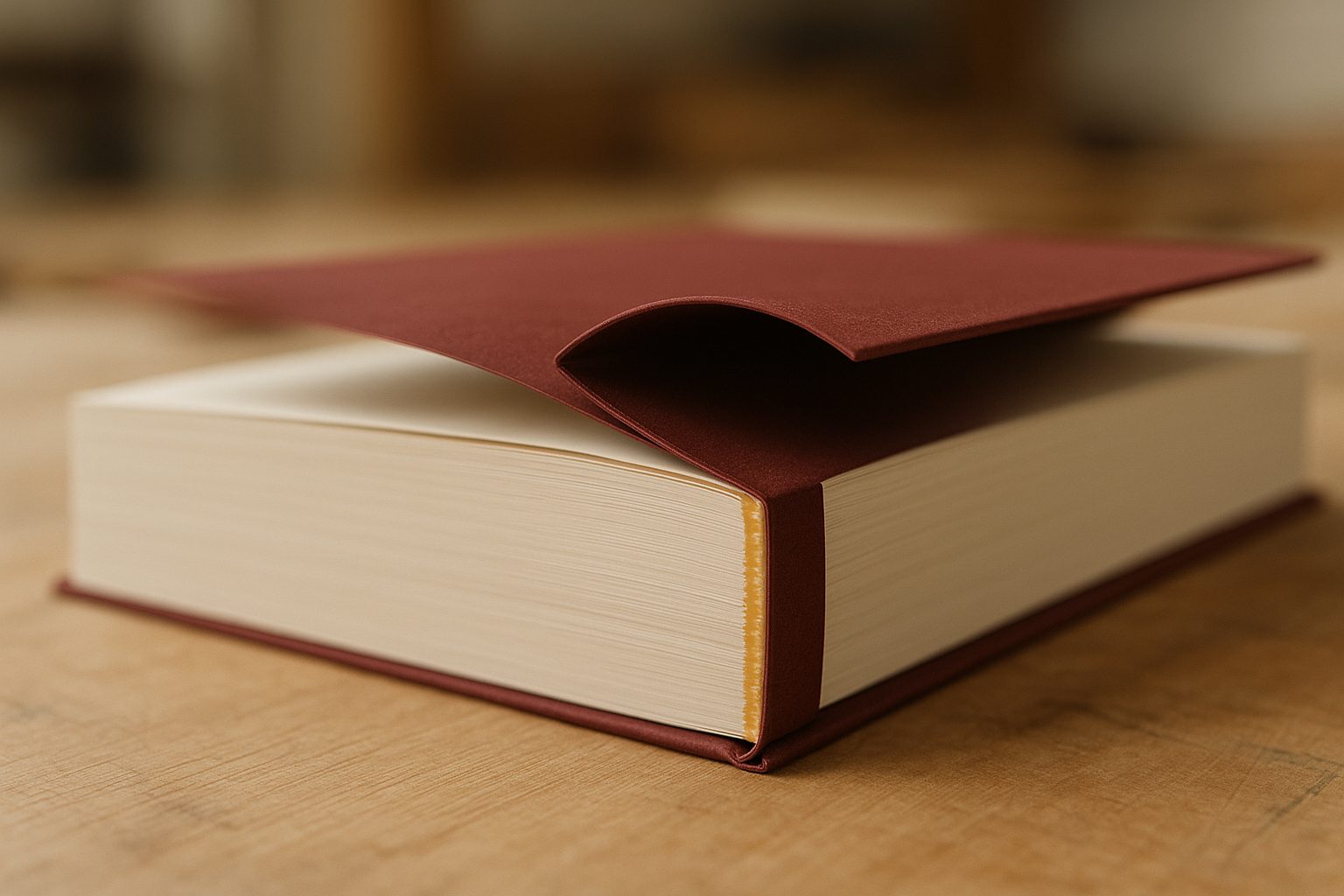
Perfect binding is the bookbinding method behind most paperbacks: the printed pages are gathered into a block, the spine edge is milled flat, a layer of hot adhesive is applied, and a card cover is wrapped around and pressed on before the book is trimmed clean on three sides. It's the standard binding for paperback books, magazines and catalogues, cost-effective, professional-looking, and quick to produce.
The name comes from the final "perfect" trim that squares the book on all edges. Below: why it's used, the two glues that matter (EVA and PUR), and exactly how a perfect-bound book is made, step by step on our own binding line in Exeter.
Advantages of perfect binding
- Professional appearance: a clean, square, printable spine that looks right on a shelf.
- Cost-effective: generally the most affordable book binding, especially against hardcover (case binding): ideal where budget matters.
- Printable spine: unlike saddle stitching, the flat spine can carry the title and author, essential for books displayed spine-out. (Spines under about 3mm are usually left blank.)
- Flexible page counts: from slim reports to thick novels, we perfect-bind spines up to 55mm.
- Durable with the right adhesive: quality glue (especially PUR) withstands frequent handling, suitable for manuals and textbooks.
- Stacks and displays neatly: square spines align evenly on shelves and in boxes.
- Any size: not limited to standard formats, custom trim sizes bind just as happily.
- Efficient production: modern binders like our Horizon BQ470 turn books around quickly at any quantity.
EVA vs PUR glue: the comparison that actually matters
"Perfect binding" describes the method; the glue decides the quality. Two adhesives are used, and choosing between them is the real decision:
| EVA (standard hot-melt) | PUR (polyurethane reactive) | |
|---|---|---|
| How it sets | Cools and sets in minutes | Cures chemically with moisture over ~24 hours, bonding into the paper fibres |
| Bond strength | Adequate for light use | Far stronger, pages are nearly impossible to pull out |
| Coated / UV / laminated stocks | Struggles to grip the coating | Bonds reliably |
| Temperature | Can soften in heat, embrittle in cold | Stable in extremes |
| Ageing | Glue can go brittle over years | Stays flexible |
| Cost | Cheapest | Slightly more |
| Best for | Standard uncoated paperbacks, short-life documents | Coated/heavy stocks, books that will be kept and used hard |
Our practical rule: EVA is fine for a standard novel on uncoated bookwove; anything on coated paper, or built to last, gets PUR. The full PUR story (the chemistry, the lay-flat question, specs and pricing) lives in our PUR binding guide. And when even PUR isn't enough (cookbooks, manuals, heirloom editions), the step up is thread-sewn binding, where stitches carry the load instead of glue.
How a perfect-bound book is made: step by step
This is the actual process on our binding line in Exeter, what happens between your PDF and the finished book.
Step 1: Print and prepare the text pages
The text is printed first (mono books on our Canon Titans, colour on the Canon 1350) on large sheets (usually SRA3), then cut into individual book blocks slightly larger than the finished trim size.
Step 2: Print and prepare the covers
Covers are printed, laminated to protect the toner, and trimmed to size, with a generous glue trap allowed for. Perfect-bound covers can also carry gatefolds, flaps that extend beyond the block and fold inside, rather like a dust jacket on a case-bound book.
Step 3: Bind the covers to the book blocks
Binding runs on our 4-clamp Horizon BQ470. Book blocks feed in one end, covers the other. As each block travels through, 2mm is milled off the spine edge (we add that 2mm when imposing the book for print), the milling roughens the spine so the glue keys into the paper rather than sitting on a smooth edge. The block passes over the glue rollers (EVA or PUR depending on the job), the creased cover is fed up to meet it, and the nipping station presses cover and block together to set the bond before the book drops to the conveyor.
Step 4: The 3-knife trim
About thirty seconds on the conveyor lets the glue cool, then the three-knife trimmer makes the cuts that give the method its name: foredge first, then head and tail, three knives, one crisp, square book with no unevenness and no stray glue.
Step 5: Quality control and packing
Every book is inspected, correct trim, no cut-off text or images, margins right, no scratched covers, spine crush, glue marks or damaged corners, then packed in single-wall cartons with bubble wrap, inside double-wall cartons for shipping.
How thin, and how thick, can a perfect-bound book be?
The practical limits on our line: a perfect-bound book needs at least 24 pages, and its spine can be up to 55mm thick, up to about 1,000 pages, depending on the paper; the calculator shows your limit. Below the minimum, saddle stitching is the right method; it binds from 8 pages.
A tip from the bindery: shrink-wrap before shipping
Alongside the double-boxing, it's worth shrink-wrapping perfect-bound books before dispatch, it prevents cover scuffing, and the compact bundles can't shift in transit.
Is perfect binding right for your book?
For most paperbacks (novels, memoirs, reports, catalogues) yes. If easier opening and repeated use are priorities, compare thread-sewn binding; if it's under about 64 pages, saddle stitching may suit better; and for the full tour of options see types of book binding. When you're ready, price your book in under a minute, the calculator handles perfect, PUR and sewn bindings at any quantity from 10 copies.
Frequently asked questions
What is perfect binding?
Perfect binding is the glued binding method used for most paperbacks: pages are gathered into a block, the spine edge is milled flat, hot adhesive (EVA or PUR) is applied, and a card cover is wrapped on before the book is trimmed square on three sides. It gives a clean, printable spine at an economical price.
What is the difference between PUR and EVA (standard perfect) binding?
The method is identical, only the glue differs. EVA is a thermoplastic hot-melt that sets in minutes but can weaken in extreme conditions and struggles on coated stocks. PUR is a polyurethane reactive adhesive that cures into the paper fibres over about 24 hours, giving a far stronger, more flexible, temperature-stable bond. Full detail in our PUR binding guide.
Is perfect binding durable?
PUR is a durable adhesive binding for many paperbacks. Paper, page count, construction and handling all affect the result. Thread sewing is an alternative for easier opening and repeated use, but neither construction makes a completely lay-flat book.
What is the difference between perfect binding and saddle stitching?
Saddle stitching staples folded sheets through the spine fold, quick and cheap, but only practical up to about 64 pages, and there's no spine to print on. Perfect binding glues a flat, printable spine and handles anything from slim reports to thick novels. Booklets and programmes suit saddle stitch; books suit perfect binding.
How many pages can a perfect-bound book have?
On our line, perfect-bound spines run up to 55mm thick: up to about 1,000 pages, depending on the paper; the calculator shows your limit. Spines under about 3mm are too thin to print on.
What is the minimum page count for perfect binding?
24 pages. Below that, saddle stitching takes over: it binds from 8 pages.
How long does PUR binding take to cure compared to EVA?
EVA sets in minutes, so books can move straight to trimming and packing. PUR reaches handling strength quickly but continues curing for around 24 hours as it reacts with moisture, the bond actually strengthens after the book is made.