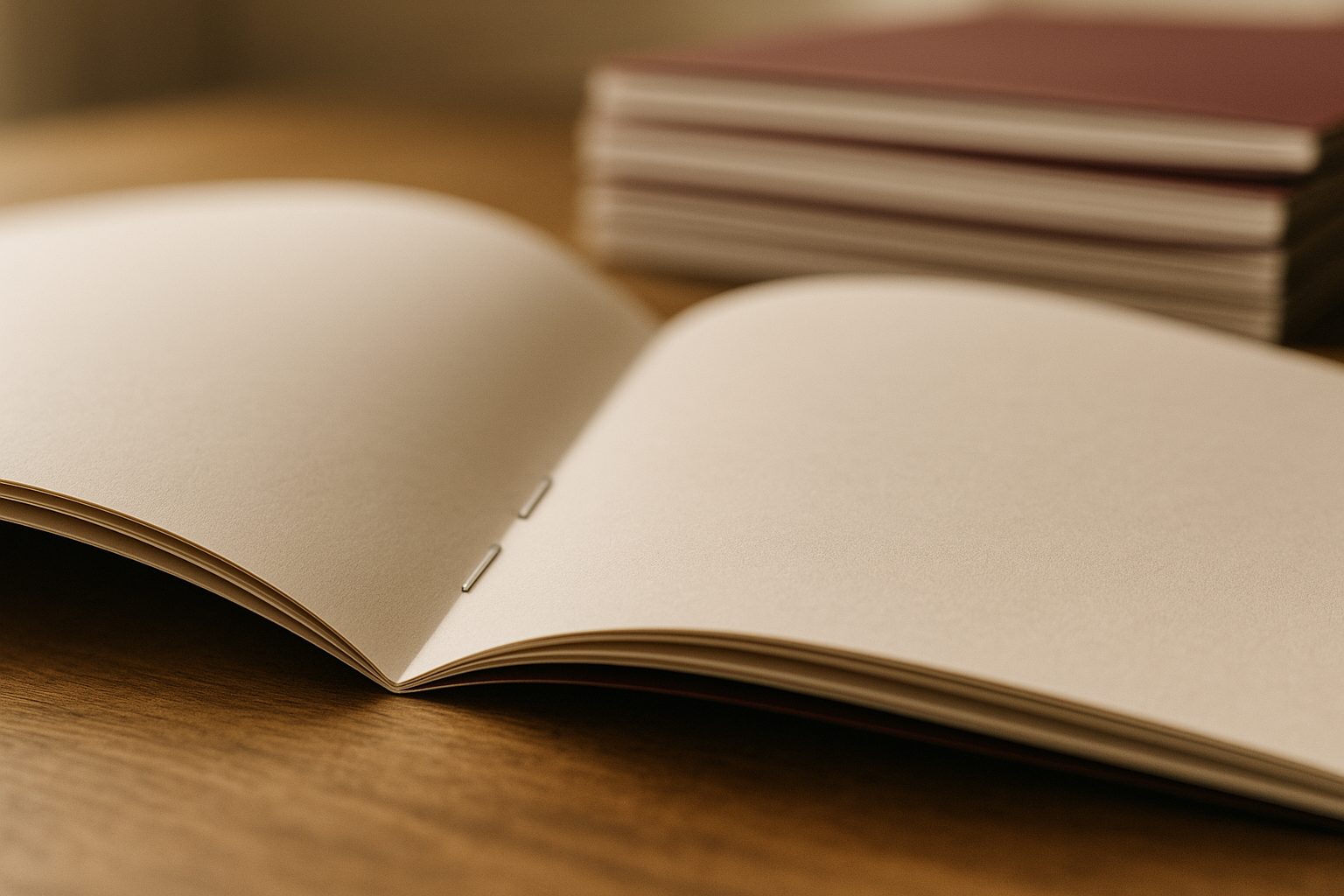
Saddle-stitch binding is the booklet binding method where folded sheets are nested one inside another and stapled through the spine fold, normally with two wire staples, called "stitches" in the trade. During binding the nested sheets hang over a saddle-shaped support, each half draping down like a rider's legs, which is where the name comes from. It's the fastest and most economical of the book binding methods, and the right choice for booklets, brochures, programmes, zines and comics from 8 to around 64 pages.
How saddle stitching works
The pages are printed on large flat sheets, several booklet pages to a side, then folded. Each folded sheet contributes four pages of the finished booklet, two on each side of the fold. The folded sheets are nested in sequence, draped over the saddle, and wire is driven through the spine fold from the outside, with the legs of each stitch clinched flat on the inside centre spread. Two stitches are standard; taller formats take three or more along the spine to stop the pages pivoting. Finally the booklet is trimmed flush on the three open edges, leaving the familiar clean, square result.
Because there's no glue to set, no case to make and no spine to build, saddle stitching is also the quickest binding to produce, which is why it's the standard for deadline work like event programmes and orders of service.
How many pages can a saddle-stitched booklet have?
The page count must be a multiple of four, covers included, fold one sheet in half and you have four pages, and every additional sheet adds four more. The practical minimum is 8 pages; the comfortable maximum is around 64 pages on standard stocks. Push past that and the staples struggle to hold the bulk, and the booklet starts to spring open rather than close flat. On very thin paper you can reach roughly 100 pages, but for anything in that territory a glued binding is usually the better answer.
If your design lands on an awkward count, say 18 pages, you either pad to 20 with blank or design-filled end pages, or tighten the content back to 16.
Page creep: the quirk to design for
Nesting sheets inside one another has a side effect: the innermost sheets sit slightly proud of the outer ones, pushed outward by the accumulated thickness of the paper around them. When the booklet is trimmed flush after stitching, the innermost pages end up fractionally narrower than the outermost, so printed content sits closer to the outer edge the nearer a page is to the centre. This is called page creep.
On an 8-page programme it's invisible. On a 64-page booklet on heavier stock it's real, which is why high-page-count saddle-stitched designs should keep critical content (page numbers, text, anything that must align) comfortably inside the outer margin, and why borders that run close to the trim edge are best avoided near the centre of the book.
Saddle stitch vs perfect binding
The decision that matters in practice: stay with staples, or move to a glued spine. The short version: under about 64 pages with no spine text needed, saddle stitch; anything more, perfect binding or PUR.
| Saddle stitch | Perfect / PUR binding | |
|---|---|---|
| Page range | 8 to 64 pages (multiples of 4) | From a spine of about 1.9mm up to several hundred pages |
| Spine | A folded, stapled edge, nothing to print on | Flat, square and printable, title and author visible on a shelf |
| Cost | Lowest of any binding, minimal setup and material | Higher, glue, milling and cover wrap add production steps |
| Opens more easily? | Yes, pages pivot easily on the stitches | No, the glued spine holds the gutter closed |
| Weight | Lightest: matters for mailed or bulk-shipped pieces | Heavier, cover stock and glue add up |
| Reads as | Booklet, programme, zine, issue | Book |
That last row decides more projects than any spec: a perfect-bound piece reads as a book, a saddle-stitched piece reads as a booklet. A 48-page exhibition catalogue can suit either, it depends whether it should feel like a programme or a publication. And frequent periodicals tend to split the same way: slim weekly and monthly titles are stitched, thicker glossies are glued, we've covered what binding magazines use separately.
What saddle stitching is used for
- Brochures and catalogues: product and sales pieces at 16 to 48 pages, where cost-per-copy and turnaround beat shelf presence.
- Event programmes and orders of service, weddings, funerals, concerts, awards nights; the binding of choice when the date is fixed. See our order of service printing.
- Comics and zines: the traditional "floppy" format: slim issues that sit flat and open easily across a stapled spine. We print these as comic books and short-run booklets.
- Newsletters, reports and handouts, school, church, society and corporate pieces produced on a repeating schedule.
- Look-books and portfolios: where a lighter, more disposable format is deliberate.
All of these are priced and produced through our booklet printing service, saddle-stitched in-house in Exeter, from 10 copies up.
Strengths and limitations, honestly
Strengths: it's the cheapest binding there is, the fastest to produce, the lightest to ship, and the pages can open relatively flat, depending on the paper and page count, all of which is why it has survived every print technology shift intact.
Limitations: the page-count ceiling is real; there's no spine to print a title on, so a stitched booklet disappears edge-on in a stack or on a shelf; and staples don't carry the archival, keep-forever signal that a sewn or glued book does. When those limitations start to matter, you've outgrown the format, move up to perfect binding, or for books meant to last decades, thread-sewn binding.
Ready to price a booklet?
Our booklet printing page covers sizes, paper choices and finishes, with live pricing, or go straight to the instant quote calculator and price your spec in under a minute.
Frequently asked questions
What is saddle-stitch binding?
Saddle-stitch binding is the booklet binding method where folded sheets are nested inside one another and stapled through the spine fold, usually with two wire staples. The nested sheets sit over a saddle-shaped support during stitching, hence the name. It's the fastest, most economical binding for booklets of roughly 8 to 64 pages.
How many pages can a saddle-stitched booklet have?
Page counts must be multiples of four (each folded sheet contributes four pages). The practical range is 8 to about 64 pages on standard stocks; very thin paper can stretch to roughly 100, but at that point a glued binding such as perfect binding is usually the better choice.
Why is it called saddle stitching?
During binding, the nested folded sheets are draped over a saddle-shaped support with each side hanging down like a rider's legs. The wire staples are then "stitched" through the spine fold. The saddle apparatus gives the method its name.
Can you print on the spine of a saddle-stitched booklet?
No, a saddle-stitched booklet has a folded, stapled edge rather than a flat spine, so there's nothing to print a title on. If your piece needs a printable spine for shelf identification, that's the signal to move to perfect binding or PUR.
What is page creep in saddle stitching?
Page creep is the way the innermost nested sheets are pushed slightly outward by the thickness of the sheets wrapped around them. After the final flush trim, inner pages end up fractionally narrower, so printed content sits closer to the outer edge near the centre of the booklet. On higher page counts, keep critical content well inside the outer margin.
Is saddle stitching cheaper than perfect binding?
Yes, it's generally the cheapest binding available. There's no glue, no spine milling and no separate cover wrap, just folding, stitching and trimming, and the result is also lighter to ship. That economy is why brochures, programmes and short-run booklets default to saddle stitch.